
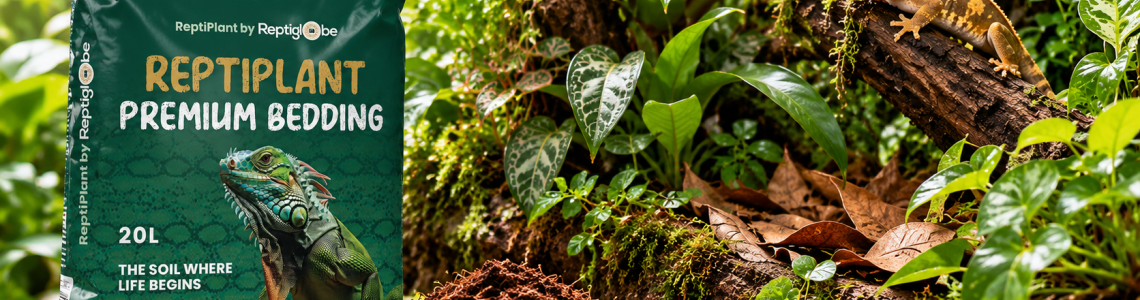
ReptiPlant: Choosing the Right Soil for a Healthy Bioactive Terrarium
Ready-to-use substrate can make setting up a natural planted enclosure much easier. Explore the properties of ReptiPlant Premium Bioactive Soil 20L, how to use it and what makes a successful bioactive habitat.
ReptiBlock ReptiPlant · Premium Bioactive SoilA bioactive terrarium is more than an enclosure containing live plants. In a well-designed ecosystem, plants, microorganisms and beneficial soil invertebrates work together. The substrate is essential: it must provide suitable moisture conditions, support plant roots and offer a suitable environment for soil organisms.
Should you buy a ready-made terrarium substrate or create your own mix? This guide explains the key considerations and when ReptiBlock ReptiPlant Premium Bioactive Soil 20L may be a practical choice.
What makes terrarium soil bioactive?
Bioactive substrate forms part of an environment in which organic material is decomposed and nutrients can be recycled. Springtails, isopods, bacteria and fungi all play potential roles.
A suitable foundation
The substrate supports plant roots and beneficial soil organisms. Moisture balance, structure and aeration are important.
A living ecosystem
Microorganisms and suitable invertebrates help decompose organic matter, while plants use available nutrients.
A bag of soil does not automatically create a functioning bioactive terrarium. Plants, climate, beneficial organisms and regular maintenance must work together.
Explore our bioactive terrarium supplies.
What makes a good terrarium substrate?
Different reptiles, amphibians and plants require different conditions. For many tropical planted enclosures, four properties are especially important.
Moisture retention
The substrate should hold enough moisture without remaining waterlogged for extended periods.
Structure and aeration
A suitable structure provides room for roots and helps prevent oxygen-poor conditions.
Plant nutrients
Plants need nutrients to grow. Some substrates contain added nutrients, while others mainly provide structure and moisture retention.
Support for soil organisms
Springtails and isopods require appropriate moisture, hiding places and food, not just substrate.
A moisture-retaining tropical substrate is not automatically appropriate for desert species or animals requiring stable, deep burrows.
Ready-made terrarium substrate or a homemade mix?
Both options can work. A homemade mix offers control over ingredients, while ready-made substrate provides a convenient starting point.
| Feature | Ready-made substrate | Homemade mix |
|---|---|---|
| Preparation | Ready to use | Ingredients must be sourced and mixed |
| Composition | Pre-formulated base | Custom ratios |
| Convenience | Quick and practical | Requires more preparation |
| Special requirements | Check product suitability | Can be tailored |
Homemade blends may be useful for specialist species or plants. Ready-made substrate is convenient when you want a consistent base without buying multiple separate ingredients.
ReptiBlock ReptiPlant Premium Bioactive Soil 20L
ReptiPlant is a ready-to-use substrate made in the Netherlands for planted and bioactive terrariums. According to the product specification, it contains coco fibre, peat, and added vitamins and minerals for plants.
Coco fibre contributes structure and moisture retention, while peat helps retain water. Added nutrients support the growth and development of live terrarium plants.
Why choose ReptiPlant?
- Ready to use
- Contains added plant nutrients
- Moisture-retaining composition
- Suitable as a base for planted bioactive terrariums
- Made in the Netherlands
- 20-litre package
Product specifications
- Brand: ReptiBlock
- Product: ReptiPlant Premium Bioactive Soil
- Volume: 20 litres
- Base: coco fibre and peat
- Additives: vitamins and minerals for plants
- Origin: Netherlands
ReptiPlant does not replace drainage, leaf litter, plants, clean-up crew organisms or proper humidity management where these are needed.
Watch the ReptiPlant video
Want a closer look at ReptiPlant? Watch the product video below.
If the player does not work, watch the video on YouTube.
ReptiPlant vs Arcadia EarthMix: what's the difference?
Both products may interest keepers looking for ready-made substrates for planted or bioactive enclosures. However, they are separate commercial products with their own formulations and recommended uses.
| Feature | ReptiPlant | Arcadia EarthMix |
|---|---|---|
| Composition | Coco fibre, peat, added vitamins and minerals | Consult current product specifications |
| Preparation | Ready to use | Check the selected variant |
| Volume | 20 litres | Depends on variant |
| Origin | Made in the Netherlands | Check current product information |
ReptiPlant is worth considering if you want a ready-to-use, nutrient-enriched 20-litre substrate. The best choice depends on the enclosure, plants and animals.
Which terrariums can use ReptiPlant?
ReptiPlant is designed as a foundation for natural planted terrariums, particularly where moisture retention, live plants and soil organisms are important.
Tropical planted terrariums
Moisture-retaining substrate can benefit suitable tropical plants. Ventilation, watering and drainage remain important.
Bioactive ecosystems
ReptiPlant can be combined with appropriate plants, leaf litter and soil organisms to create a living environment.
For arid, heavily burrowing or specialist species, check whether its moisture characteristics and structure are appropriate before use.
How to use ReptiPlant in a terrarium
- Identify your animals' and plants' needs. Choose a substrate suited to the natural habitat.
- Plan the substrate layers. Add drainage and a permeable barrier if appropriate for the setup.
- Spread ReptiPlant. Provide sufficient depth for plant roots and any relevant digging behaviour.
- Add suitable plants. Remove inappropriate potting soil or fertilisers.
- Add leaf litter. This can provide shelter and food for soil invertebrates.
- Introduce suitable clean-up crew organisms. Choose springtails and isopods appropriate for the habitat.
- Monitor moisture. Keep the substrate appropriately moist without prolonged saturation.
- Allow the system to establish. Check plants, soil organisms and climate before introducing animals.
Explore our bioactive terrarium range for additional setup materials.
Combining ReptiPlant with springtails and isopods
Springtails and isopods are commonly used as a clean-up crew. They help break down certain fungi, fallen leaves and other organic matter.
Springtails
Many springtails thrive in humid soil conditions and consume fungi and decaying material.
Isopods
Suitable isopod species process leaf litter and decomposing plant material. They need hiding places and appropriate moisture.
ReptiPlant can provide a substrate base, but clean-up crew success also depends on food, shelter, temperature and humidity. Not every species is suitable for every enclosure.
Maintaining ReptiPlant in a bioactive terrarium
Daily
- Check temperature and humidity
- Observe animals and plants
- Remove leftover food and visible contamination
Weekly
- Check substrate moisture
- Inspect plant health and growth
- Check drainage and ventilation
- Monitor clean-up crew activity
Periodically
- Replenish leaf litter
- Prune plants
- Check substrate structure and odour
- Replace contaminated or unsuitable areas
Stable bioactive substrate may not need frequent complete replacement, but regular maintenance remains essential.
Common bioactive substrate mistakes
Overwatering
Constantly soaked soil may become oxygen-poor and harm plant roots.
Ignoring species requirements
Not every reptile or amphibian needs moisture-retaining substrate.
Forgetting the clean-up crew
Substrate alone does not create a functioning bioactive ecosystem.
Insufficient ventilation
Moist substrate must be combined with appropriate airflow.
Insufficient substrate depth
Roots and burrowing animals need suitable depth and structure.
Skipping maintenance
Bioactive terrariums still require inspection and spot-cleaning.
Frequently asked questions about ReptiPlant
What is ReptiPlant Premium Bioactive Soil?
It is a ready-to-use terrarium substrate made in the Netherlands by ReptiBlock. Its stated ingredients are coco fibre, peat and added vitamins and minerals for plants.
Can I use ReptiPlant straight from the bag?
Yes. It is supplied ready to use, although you must confirm that it suits your plants and animals.
Can ReptiPlant support springtails and isopods?
It can serve as a substrate base for a bioactive setup. Their survival also depends on moisture, temperature, shelter and food.
How does ReptiPlant compare with Arcadia EarthMix?
They are different commercial substrates. ReptiPlant contains coco fibre, peat and added vitamins and minerals. Check current EarthMix specifications for the selected variant.
Do I need a drainage layer?
It depends on the setup. Drainage may be useful in humid, heavily planted terrariums, but is not necessary in every habitat.
Should I add leaf litter?
Leaf litter can provide food and shelter for soil organisms. The amount depends on the habitat and species.
Can ReptiPlant be used in arid terrariums?
Suitability must be assessed for each species. Its moisture-retaining properties are not automatically appropriate for desert habitats.
Is a bioactive terrarium maintenance-free?
No. Regular checks of animals, plants, substrate moisture, ventilation and hygiene remain necessary.